


If you’re weighing Bolton for buy-to-let or a first purchase with upside, you’re looking at a commuter market with clear demand signals. You can reach Manchester in roughly 15–25 minutes by rail, and areas near Bolton and Horwich Parkway often let you price in convenience without paying city premiums. That gap can support steadier yields and resale liquidity—but only if you pick the right neighbourhood, budget band, and transport trade-offs…
Key Takeaways
- Bolton’s rail links deliver 15–25 minute trains to Manchester, supporting sub-40 minute commutes that raise renter and buyer demand.
- Demand is strongest near Bolton and Horwich Parkway stations, where walkable catchments and park-and-ride improve commute reliability.
- Heaton and Lostock attract higher-income families seeking larger homes and strong schools, reducing void risk and stabilising rents.
- Horwich near Middlebrook offers amenities and employment access that support longer tenancies and resilient pricing.
- Farnworth remains discounted, but regeneration and retail upgrades are improving yields and buyer interest in selected streets.
Best Bolton Neighbourhoods for Manchester Commuting
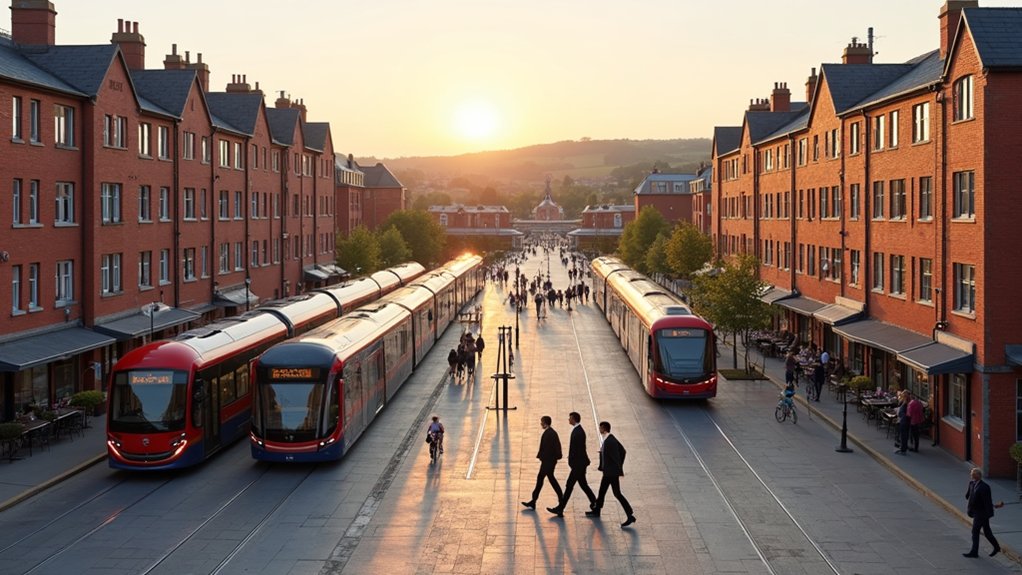
Because most ROI in Bolton hinges on how quickly tenants and buyers can reach Manchester, you’ll get the strongest commuter-led demand in neighbourhoods with fast rail access and easy M61/M60 connectivity—so prioritise areas around Bolton and Horwich Parkway stations (walkable catchments), plus well-served estates near key bus corridors where commute times stay predictable during peak hours.
Target Heaton and Lostock for higher-income renters seeking larger homes, strong schools, and low void risk.
Back Farnworth selectively where pricing stays discounted but regeneration and retail upgrades lift yields.
In Horwich, buy near Middlebrook for local amenities that reduce car dependence and support longer tenancies.
In Westhoughton, focus on family streets with parks and a stable community vibe.
Always stress-test rent against service charges and parking constraints.
Bolton Train, Bus, and Driving Times (What to Expect)
While Bolton sits only about 10–15 miles from Manchester, your ROI usually comes down to whether tenants can hit a repeatable sub‑30–40 minute door‑to‑door commute—so benchmark every deal against real-world train frequency to Manchester Piccadilly/Victoria, peak-hour bus journey times, and M61/M60 driving variability.
Then price in the costs that can break the numbers (parking, season tickets, and any station-adjacent service charges).
Expect fast trains to Manchester in roughly 15–25 minutes, but don’t underwrite on best-case: check peak headways and late-evening gaps.
Buses can stretch to 45–75 minutes in traffic, so treat them as secondary unless routes are direct.
Driving can be 25–60+ minutes at peak; run commuting time comparisons at 8am/5pm.
Track Public transport improvements (timetables, capacity, park-and-ride) because reliability lifts achievable rents and reduces voids.
Bolton House Prices by Budget (Terrace to Detached)
Commute reliability sets your rent ceiling and void risk, but the purchase price determines whether the yield stacks up, so you need a clear budget-to-stock map in Bolton.
Under £120k, you’ll mostly target Affordable apartments and a few compact terraces; expect lower maintenance but tighter capital upside, so stress-test service charges.
£120k–£180k buys standard terraces in lettable streets; run a 6% gross-rent target and budget 8% for refurb.
£180k–£260k opens larger terraces and entry semis; you’ll typically reduce churn with better parking and schools access.
£260k–£400k puts you into family semis and some detached stock; capex rises, but voids can drop if you spec for commuters.
Above £400k, you’re competing for Luxury estates—prioritise resaleability over headline rent.
2026 Outlook for the Bolton Property Market (Local Drivers)
If you’re underwriting Bolton for 2026, anchor your assumptions to a few local drivers that move both rent growth and exit liquidity: how Manchester-bound connectivity performs, where employers and logistics clusters actually add jobs, and whether new-build supply lands in the same tenant catchments you’re targeting.
Model Market growth off rail reliability to Manchester, not headlines: stronger peak capacity supports higher achievable rents and lower voids.
Track demographic trends by postcode—young renters and family movers behave differently on rent sensitivity and lease length.
Stress-test supply: if pipeline flats concentrate near town centre, protect yields with scarcity assets (3-bed semis, parking, gardens) in commuter belts.
Underwrite exits using comparable days-on-market; falling DOM signals liquidity and tighter pricing.
Frequently Asked Questions
Are There Any Major Flood Risk Areas Affecting Bolton Home Insurance Costs?
Yes—some Bolton pockets near the River Croal and tributaries can raise costs; think of my friend’s “leaky umbrella” quote after a mapped floodplain hit. Check Flood zone designations; insurers price Insurance premium factors like history.
What Are the Best Primary and Secondary Schools in Bolton for Families?
You’ll find top Bolton schools by checking School rankings and Ofsted: primary—Markland Hill, St Peter’s Smithills Dean, St Thomas of Canterbury; secondary—Canon Slade, Thornleigh Salesian, Bolton School. Prioritise Education quality, catchment, exam results.
Is Bolton Popular With Landlords, and What Rental Yields Are Typical?
Yes—you’re likely to find Bolton popular with landlords. Typical gross yields run ~5–8% depending on area and property type. Track rental market trends, negotiate landlord incentives, and stress-test voids, maintenance, and rate rises.
How Safe Is Bolton, and Which Areas Have Lower Crime Rates?
Bolton’s safety is a patchwork quilt: you’ll find safer pockets. Check Neighborhood safety via local Crime statistics; focus on Heaton, Lostock, and parts of Horwich. You’ll reduce risk, voids, insurance costs, and boosts ROI.
What Regeneration Projects Could Impact Bolton’s Amenities and Property Values?
You should watch urban renewal in Bolton town centre, transport upgrades, and housing-led schemes; they’ll lift footfall and rents. Track new community facilities, schools, and public space spend, since they can compress yields and boost resale.