


You can still find a Northwest town where two major city job markets prop up yields, and Warrington is it. You’re within roughly 20–25 minutes by rail to both Manchester and Liverpool, plus you’ve got the M62/M6 for flexible commuting. That connectivity keeps demand resilient and limits voids, even as prices climb. If you’re targeting ROI, the key is which neighbourhoods are accelerating first—and what could change next.
Key Takeaways
- Warrington’s position between Manchester and Liverpool drives commuter demand, pushing prices up faster than many nearby towns.
- Fast rail links from Bank Quay and Central expand buyer and tenant pools, supporting higher rents and stronger resale values.
- M62/M6 connectivity attracts drive-to-work households and employers, strengthening local job growth that underpins property demand.
- Limited new-build supply against rising demand creates a supply gap, sustaining upward pressure on prices and reducing time on market.
- Regeneration and amenities near stations, employment parks, and schools boost desirability, lowering vacancy risk and supporting long-term appreciation.
Why Warrington Property Prices Are Rising Now
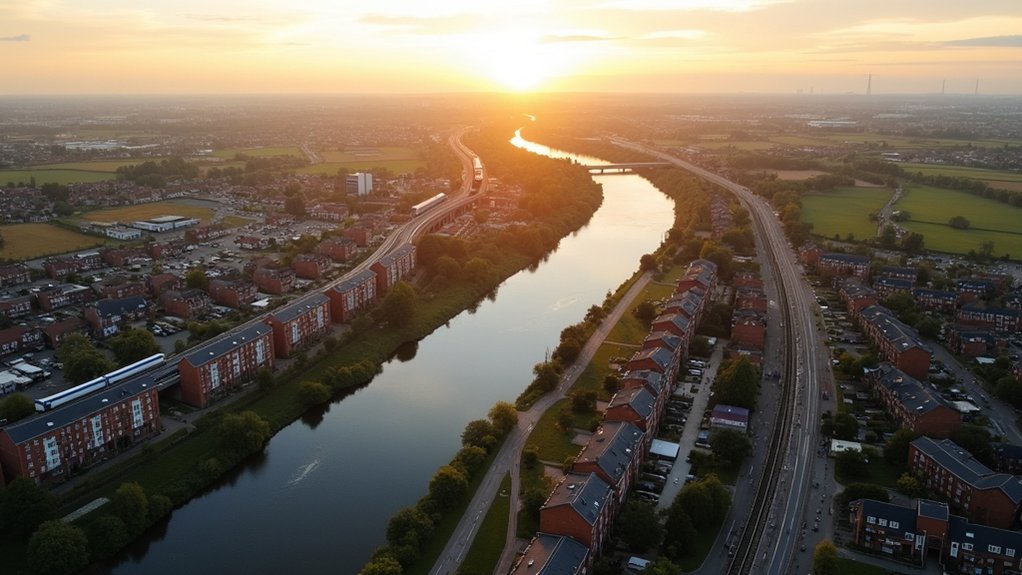
While national growth has cooled in pockets, Warrington’s prices are rising because you’re buying into a tightening supply-and-demand equation: strong commuter demand from Manchester and Liverpool, steady job creation across logistics and advanced manufacturing, and limited new-build stock in the most in-demand postcodes.
To capture ROI, you should target areas where rental demand outpaces supply: near major employment parks, town-centre retail, and top-rated schools.
Compare asking prices to achieved rents and stress-test yields after mortgage rates, insurance, and voids; you’ll spot streets where a 5–7% gross yield still pencils out.
Look for properties that qualify as affordable housing in regeneration zones, because they attract consistent tenants and lower arrears risk.
Prioritise walkable local amenities—supermarkets, gyms, GP surgeries—since they reduce vacancy and support faster resale.
Warrington to Manchester & Liverpool: Commute Times and Rail Links
Because commute friction directly shapes tenant demand, Warrington’s fast rail and road links to both Manchester and Liverpool make it a high-liquidity buy: you can get into Manchester in roughly 20–35 minutes and Liverpool in about 25–45 minutes by train from Bank Quay or Central, with frequent peak services that suit 9–5 and shift patterns.
Target stock within a 10–15 minute walk of either station to widen your tenant pool and reduce voids. If you’re optimising yield, price in season tickets and parking scarcity: tenants pay for convenience, so tighter catchments support stronger rents.
Public transport reliability also helps corporate lets and flatshares. Don’t ignore Road infrastructure either—M62/M6 access improves drive-to-work appeal and supports blended rail+car commutes.
Warrington Jobs and Regeneration Driving Buyer Demand
As Warrington expands its employment base and pours capital into regeneration, you’ll typically see buyer demand tighten and rents hold firmer through cycles. Track job growth in logistics, manufacturing, and professional services: rising payrolls usually translate into faster absorption and fewer void periods.
To protect ROI, prioritise stock near major employment zones and transport interchanges, where Urban expansion is planned and vacancy risk drops. Check council regeneration pipelines for public space upgrades, new commercial space, and improved Local amenities; these often support higher achievable rents and stronger resale multiples.
Stress-test numbers: target rent cover above 125% at a 6% stress rate, and budget 8–10% for maintenance on older terraces. Finally, watch employer announcements and planning approvals quarterly; they move demand before headline price indices.
Fast-Rising Warrington Neighbourhoods for Buyers and Investors
If you want to capture Warrington’s upside before it fully prices in, you’ll get the best risk-adjusted returns by targeting neighbourhoods where sold-price momentum, rental demand, and planned infrastructure overlap.
Start with Central Warrington around Bank Quay and the town centre: you can back Luxury apartments aimed at commuters, then benchmark yields against comparable units near Manchester and Liverpool links.
Next, look at Stockton Heath for resilient demand, low voids, and strong tenant profiles; prioritise walk-to-amenities streets and off-road parking.
For value-with-upside, target Padgate and Birchwood, where transport access supports stable lets and family buyers.
Finally, consider Grappenhall and other historic villages: you’ll pay more, but schools and scarcity help protect resale.
Track sold-price per sq ft quarterly and negotiate on days-on-market.
What Could Move Warrington Property Prices Next (Risks + Upsides)

Whether you’re buying to let or to resell, Warrington’s next leg of price movement will hinge on a tight set of ROI drivers—interest-rate cuts (and mortgage availability), employer hiring across the M62 corridor, and transport/infrastructure delivery—while the biggest downside risks come from affordability caps, new-build supply landing at once, and stricter rental regulation squeezing yields.
Track Market affordability by stress-testing deals at +1–2% mortgage rates and checking sold-price-to-income ratios versus nearby Manchester/Liverpool.
On the upside, target homes within walkable Local amenities (stations, retail parks, schools) where tenant demand stays sticky and voids fall.
Watch planning pipelines: if large schemes complete together, negotiate hard on price and incentives.
Finally, run yield scenarios for EPC upgrades and licensing so compliance doesn’t erase your margin.
Frequently Asked Questions
What Are the Typical Council Tax Bands and Annual Costs in Warrington?
In Warrington, you’ll typically see Council tax bands A–H, tied to 1991 property valuation. Annual costs run roughly £1,400–£4,200+ (2025/26). Check your band, compare streets, and budget tax in ROI calculations.
How Do Warrington School Ofsted Ratings Vary Across Different Neighbourhoods?
You’ll see Ofsted vary by neighbourhood: some clusters score Good/Outstanding, others sit Requires Improvement, driving school inspection differences and educational quality disparities. For ROI, compare catchment maps, recent reports, and appeal trends before buying.
What Are Average Rental Yields for Flats Versus Houses in Warrington?
You’ll see sky-high yields: flats average 5–7% in Warrington, while houses typically return 4–6%. Track Rental market trends, run Investment property analysis, target low-void areas, negotiate hard, and stress-test mortgage rates for ROI.
Are There Flood-Risk Zones in Warrington That Affect Mortgage Approvals?
Yes—some Warrington areas sit in higher flood-risk zones, and lenders may require a Flood risk assessment, extra surveys, or decline. You’ll face Insurance implications too; check EA flood maps, price in premiums, negotiate.
What Are Current Stamp Duty and Conveyancing Costs for Buying in Warrington?
In Warrington, you’ll pay 0–12% Stamp Duty (plus 3% surcharge if you’re buying-to-let) and typically £900–£1,800 conveyancing. Since 2024 thresholds reset, model costs early for property investment ROI amid market trends.