
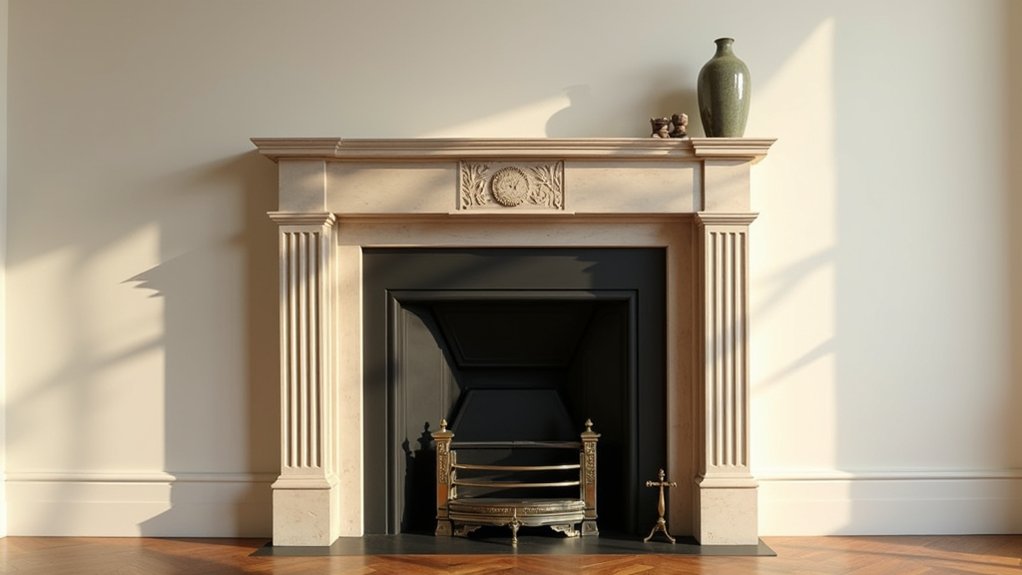

What is it about the classical Georgian fireplace that just adds style to a room? In many Georgian houses, the fireplace takes up nearly a third of the chimney-breast wall, and that ratio still feels right today. You get a calm focal point because the surround follows strict symmetry and tight proportions. Run your hand along the molding and you’ll notice crisp arises, clean mitres, and joints that don’t wander. Choose stone, marble, or painted timber and the room’s tone shifts fast—but only if you size it correctly…
Key Takeaways
- Its strict symmetry and calm proportions create a balanced focal point that suits both period and modern rooms.
- A rectilinear opening with simple architrave, flat frieze, and restrained shelf delivers elegance without ornament.
- Quality originals show crisp arises, tight joints, and precise carving in marble, limestone, or painted timber.
- Well-judged sizing—often a 10:9 opening ratio and surround about one-third wider—keeps the composition upright and coherent.
- Durable, heat-ready materials and minimal accessories make it practical, easy to maintain, and visually uncluttered.
What Is a Classical Georgian Fireplace?
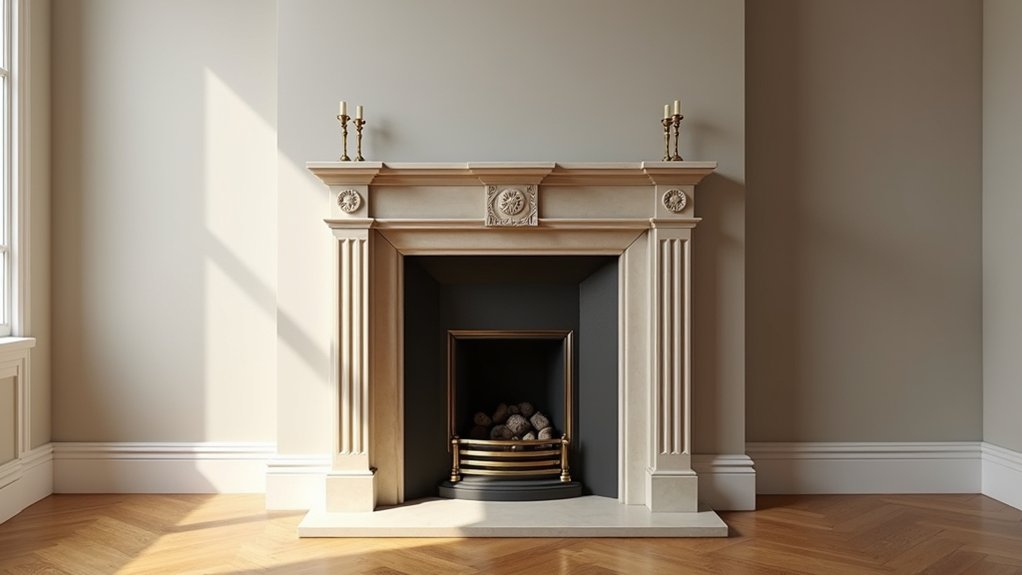
Although details vary by house and region, a classical Georgian fireplace is a balanced, rule-driven surround built around strict symmetry and clean proportions. You’ll typically see a rectilinear opening framed by a simple architrave, with a flat frieze and restrained shelf, all aligned to the room’s centerline.
In Historical context, it served as a tidy architectural focal point for polite rooms, often paired with plaster cornices and timber floors rather than rustic stonework. You can identify originals by crisp arises, lime-based bedding, and tight joints in marble, limestone, or painted timber.
Renovation tips: check for a sound lintel, soot-stained masonry, and later cement pointing; use breathable lime mortar and match stone grain and finish. As reclaimed Georgian Fireplaces are becoming more fashionable, you’ll appreciate why this is.
Georgian Fireplace Proportions: The Quick Rule of Thumb
When you’re setting out a classical Georgian fireplace on site, start with a simple height-to-width ratio for the opening so the composition reads calm and upright against the chimney breast.
Keep the surround in balance with that opening—stone or marble needs enough face width to feel grounded, but not so much that it crowds the fire.
Mark these lines out full-size before you cut, and you’ll see immediately whether the opening and surround sit in proportion.
Ideal Height-To-Width Ratio
To get Georgian fireplace proportions right without endless measuring, start with a simple height-to-width rule: keep the opening slightly taller than it’s wide (roughly a 10:9 ratio). Mark it out on site with painter’s tape, then step back to check sightlines from doorways and seating.
In brick, that ratio keeps courses clean and avoids awkward cut units; in stone, it reduces skinny slips that crack at the arris.
If you’re fitting a cast-iron insert, match the visible opening to the insert’s face while preserving the 10:9 look. Choose fireplace accessories—fire basket, dogs, and a low fender—that sit below the opening’s midpoint so the proportion reads taller.
For longevity, follow maintenance tips: keep joints tight, clear ash lines, and watch for heat-spalled brick at the jambs.
Surround And Opening Balance
If the opening sets the fireplace’s “face,” the surround gives it shoulders, so you can’t size one without checking the other on the wall. Start by centering the opening on the room’s main axis, then set the jambs so the surround reads about one-third wider than the opening, not half.
Keep the frieze and shelf depth modest in shallow rooms; in stone, 25–40 mm projection often suffices, while timber can take a crisper 15–25 mm.
On site, measure skirting height and cornice lines so the surround’s outer edges don’t collide with trim. This balance supports fireplace maintenance access around returns and reveals its historical significance without looking oversized or timid.
Check ash clearance too.
Georgian Fireplace Details That Show Craftsmanship

On site, you’ll spot Georgian craftsmanship in hand-carved mantel moldings where the profiles stay crisp and the returns align cleanly at the corners.
You can read the room in the symmetry too—straight, mirrored lines and consistent reveal widths that keep the opening and surround visually balanced.
Then check the masonry: tight stone joints, true faces, and clean joinery where hearth, jambs, and lintel meet without gaps or awkward packing.
Hand-Carved Mantel Moldings
Although the firebox draws your eye first, hand-carved mantel moldings are where a Georgian fireplace proves its craftsmanship up close. You’ll see crisp ovolo edges, tight fluting, and clean stop-chamfers that don’t blur under paint.
Run a light across the profile on site: sharp shadow lines mean the carver cut with control, not a router. In limewood or mahogany, you get finer detail; in oak, you’ll notice bolder facets that resist chipping.
You should check corners and returns for matched grain and pinned joints, especially under heavier mantel shelf styles. If you’re fitting fireplace accessories, confirm the molding’s projection leaves clearance for brackets, screens, and tool stands.
Proper sealing and breathable primers keep carved edges from swelling or softening over years.
Symmetrical Proportions And Lines
Sharp carved profiles only read as “Georgian” when the whole fireplace holds a strict centerline, so check symmetrical proportions and lines next. Stand square to the opening and mark the center on the hearth and wall; your eye should see equal returns, equal jamb widths, and a level mantel shelf.
Measure from center to each outside edge of the surround and to each inside edge of the firebox; mismatches show instantly once paint hits. Keep Mantel designs calm: align pilaster faces, frieze banding, and any panel breaks so they mirror cleanly.
On site, confirm the shelf overhang matches left to right and that the depth reads even against adjacent skirting. Place Fireplace accessories in pairs, or one centered, so the geometry stays disciplined.
Fine Stonework And Joinery
When you look close, Georgian character shows up in the stonework and joinery rather than in extra ornament. You’ll notice tight joints, crisp arises, and hearth stones that sit flat without rocking. Run a straightedge across the jambs and lintel: good work keeps the planes true, so smoke draws cleanly and the surround reads calm.
If you’re restoring, match the original stone’s grain and tool marks, not just its colour.
Check how the timber mantel fixes to masonry; proper joinery uses housed joints and concealed screws so seasonal movement won’t split corners. Marble accents should sit on stable bedding, with fine shims, not thick adhesive.
Set decorative tiles on an even backing, keep grout lines narrow, and align patterns to the centreline.
Best Georgian Fireplace Surround Materials (and Why)

Because the surround sits closest to heat, soot, and daily contact, you’ll get the best Georgian fireplace results by choosing a material that matches your room’s conditions as much as its period look.
If you burn regularly, dense limestone or marble shrugs off heat and wipes clean; seal it to resist staining and soot shadowing.
In damp cottages or coastal homes, slate handles moisture swings and stays stable, with a quieter, darker Georgian feel.
For painted schemes, hardwood (often pine) lets you sharpen mouldings, but you’ll need proper clearances, a fire-rated backer, and durable paint for knocks.
Cast stone suits tight budgets and straight walls, and it’s easy to tune for Victorian decor or Contemporary updates.
Georgian Fireplace Sizes by Room
Although Georgian fireplaces follow balanced proportions rather than one fixed measurement, you’ll get the most convincing result by sizing the opening and surround to the room’s scale, the flue you’ve actually got, and the fuel you plan to burn.
In a small parlour or bedroom, keep the firebox modest and the jambs tight so the hearth doesn’t dominate; a deep stone or brick back helps reflect heat.
For a mid-size dining room, widen the opening, but keep the lintel height restrained and match the surround thickness to plaster reveals.
In larger reception rooms, you can justify a broader span and deeper hearth, especially in dense marble or Bath stone.
Measure existing soot lines, corbels, and hearth scars during historic restoration, and plan fireplace maintenance access to the throat and register area.
Making a Georgian Fireplace Work in Modern Rooms
Even if you’re fitting a Georgian surround into a modern open-plan room, you can keep the period look by treating it as part of the wall build-up, not a standalone ornament. Set it on a proper non-combustible hearth—stone, slate, or tiled—and run a crisp lime plaster return to the edges so the mouldings read as architecture.
If you’re chasing Modern heating performance, hide a sealed stove or gas cassette behind a simple, dark firebox and line the flue to suit the appliance. Keep clearances tight but compliant, and insulate the chimney breast where you can to stop draughting.
Finish with Contemporary accessories: a minimal fender, matte-black tools, and a low, flush vent grille that won’t shout. Paintwork should be durable and wipeable too.
Original vs Replica Georgian Fireplaces: What to Check
If you’re weighing an original Georgian fireplace against a good replica, check the fabric first and the story second. Look for crisp arises on stone, tight joints, and tool marks that match the period; softened edges can signal later reworking. On timber surrounds, probe for old growth grain, pegged joints, and shrinkage cracks rather than fresh machining.
Next, verify Material authenticity: is it Bath stone, statuary marble, or cast iron of the right gauge, or a resin composite dressed up with filler? Check the back and underside for modern fasteners, epoxy, or uniform CNC routing.
For Historical accuracy, measure opening proportions and lintel depth against your chimney breast, and confirm the register plate, flue liner, and hearth construction suit current regs.
How to Style a Georgian Fireplace (Without Fuss)
When you treat the fireplace as the room’s fixed datum, styling it gets simple: keep the surround crisp and let the materials do the work. If it’s marble, polish lightly and avoid busy ornament on the mantel. If it’s painted timber, use a durable eggshell and sharp edges; mask the inner return to keep lines true.
Build color schemes from the stone: warm veining suits clay, ochre, and tobacco; cooler marble takes slate, ink, and off-white. Keep the hearth clear, with one brass set or iron dogs, scaled to the opening.
Add lighting accents by washing the jambs with a picture light or two low lamps on flanking tables, not on the shelf. Finish with one framed piece centered, hung just above the frieze.
Frequently Asked Questions
What Does a Georgian Fireplace Typically Cost to Install Today?
You’ll typically pay $3,000–$12,000 installed, depending on marble or cast iron, chimney lining, and site access. If you need fireplace restoration for historical accuracy, budget $8,000–$25,000 including hearth, surrounds, labor.
Do Georgian Fireplaces Require Planning Permission in Listed Buildings?
Yes, you’ll usually need listed building consent, and sometimes planning permission, to install or alter Georgian fireplaces. You must show Historical authenticity and Architectural preservation, matching stone, brickwork, lime mortar, hearth depth, and flue lining.
How Energy-Efficient Is a Georgian Fireplace Compared to Modern Stoves?
Open Georgian fireplaces often deliver only 10–20% efficiency, while modern wood stoves reach 70–85%, so you’ll burn far less seasoned oak on site. You can keep Historical authenticity and aesthetic appeal, but lose heat.
Can I Convert a Georgian Fireplace to Gas or Electric Safely?
You can, but you’ll need a Gas Safe engineer or qualified electrician. You’ll check chimney, lintel, hearth stone, and ventilation, then fit a flue liner or fused spur, balancing Historical authenticity with Modern adaptations safely.
What Maintenance Does a Georgian Fireplace Surround Need Over Time?
You’ll need regular Fireplace cleaning and inspections: dust weekly, vacuum soot, and keep the opening clear. For marble, use pH‑neutral cleaner; for timber, wax lightly. Schedule Surround restoration for chips, loose joints, scorching.